What Simple Living Actually Looks Like When Your Home Doesn’t Look Like Everyone Else’s
Have you ever searched “simple living” and come away feeling more exhausted than when you started? Don’t worry, you’re not alone. You’re also not doing it wrong. You’re just not the person most of those posts were written for.
Somewhere along the way, simple living became shorthand for a very specific aesthetic: shiplap walls, a well-stocked farmhouse pantry, a partner who splits the grocery budget, a handful of small children learning to bake and folding linen napkins. It’s a beautiful picture. One I’ve dreamed of for myself over the years. What I’ve come to learn is that it’s just not the only one.
Simple living looks different for women who live alone, who share a home with roommates or who are navigating a multigenerational household. It requires different rhythms, different anchors, and really, a different conversation entirely. That’s what this is.
What simple living is and what it isn’t
Simple living is not an aesthetic. It is not a house style, a Pinterest board or a particular type of linen. It is a set of choices about what gets your attention and what doesn’t.
At its core, simple living means deliberately reducing resistance so that what remains has space to actually matter. Making space easier to occupy in your home, your schedule, your spending, your mental load is a principle that works regardless of whether you share your home with a spouse, a roommate, a parent or no one at all.
What it isn’t: a rule that your home must be immaculate. A requirement to quit your job, grow your own food or spend Sunday afternoons batch-cooking in ceramic bowls. A lifestyle exclusively available to people with partners and walk-in pantries. The farmhouse version of simple living is one expression of this. But it’s not the definition of it.
Why it looks different depending on how you live
The honest conversation that almost nobody is having: the logistics of simple living change entirely based on your household structure.
If you live alone, simplicity isn’t about convincing anyone else to go along with it. It’s about designing a home that supports you, your rhythms, your energy and your need for rest. It’s your life holistically without the overhead of managing a shared space. The challenge is different: motivation without external accountability and permission you only have to give yourself.
If you share a home, with roommates, housemates or a partner, you may be navigating other people’s stuff, other people’s systems and other people’s definitions of “home.” Simple living here often starts with your own room, your own corner, your own quiet practice rather than the whole house.
If you’re in a multigenerational household, and perhaps caring for an elderly parent, simplicity requires negotiation. You’re not simplifying a solo environment; you’re finding the overlap between what genuinely serves everyone. That’s a different kind of skill.
None of these is a compromise. They’re just different starting points.
The principles that hold across all of it
Whatever your household looks like, there are a few things that remain true.
1. Your home should work for your actual life, not a hypothetical one. This is the first and most important principle. Not the life you’re planning to have, not the life you used to have, not the life that looks good on a vision board. The one you are actually living today, in this home, at this season.
For me, this looks like being care-taker for our family home as well as our family matriarch. I’ve lived both alone but with a shared kitchen and with roommates with only my bedroom as my own. Each season has its own blessings.
2. Small and consistent beats big and occasional. A five-minute tidy at the end of the day does more for your sense of home than a full Saturday deep-clean that leaves you depleted. Simplicity is maintained in small actions, not grand gestures.
I’m still learning this nugget myself! I’ve found it’s best to give yourself grace to be flexible as energy levels permit.
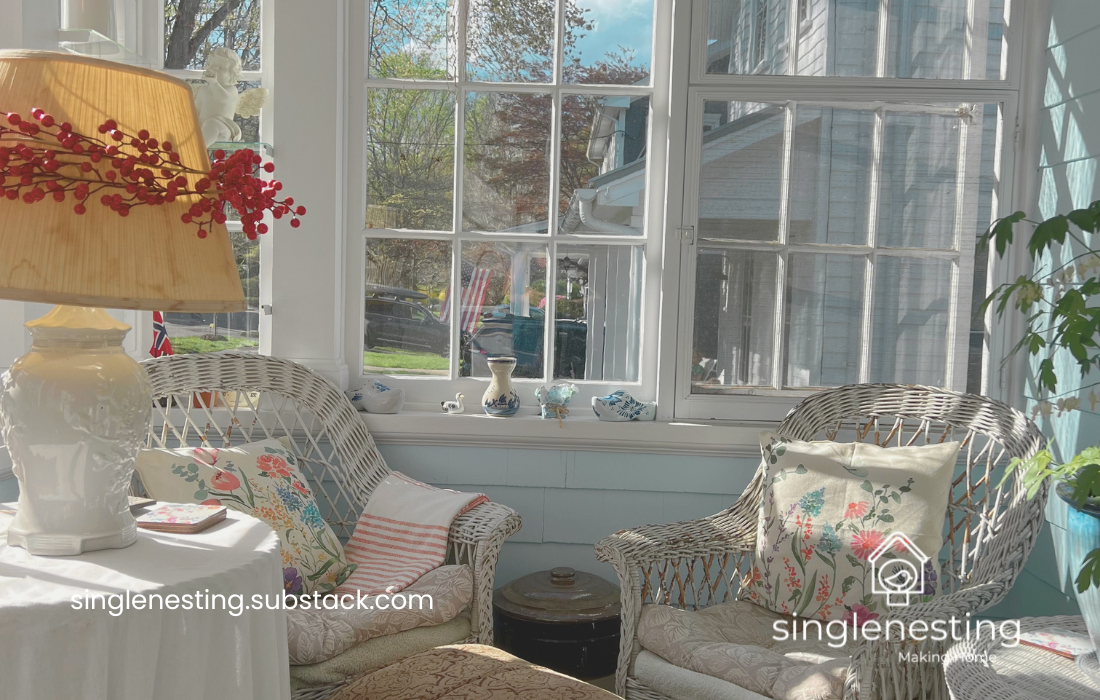
3. Visual calm is worth protecting. You don’t need a minimalist home. You need a home where your eyes can rest. That might mean one clear surface in the kitchen. It might mean a single corner that’s always tidy. It might mean a vignette of treasures you love looking at. Start there.
One of my favorite pastimes is to create a lovely scene for my eye to land. This is easy enough for a living room or bedroom. But in a high function room, like the kitchen, this means being practical and beautiful. Placing everyday ingredients together on a lazy susan or a tray creates meaning, intention and ease when it’s time for cooking. It also lessens any visual clutter because they’re grouped together, not scattered around.
4. Ownership has a cost beyond the price tag. Every object in your home requires a decision: where it lives, when to use it, when to clean it, what to do with it when you’re done. Simple living means being honest about that cost and choosing accordingly.
This doesn’t mean decluttering everything. Simple living also means living with the things you love and that bring you joy. There are methods, like rotating decor from season to season or on a whim, where you can keep your stuff and feel like there’s room to breathe in your home.
What it looks like in practice: small daily rhythms
Simple living isn’t a project you complete. It’s a set of rhythms you return to again and again.
In the morning, it might look like making your bed before you open your phone. Not because a tidy bed changes your life, but because it’s one small thing accomplished, one small signal of intention before the day picks up speed. In the kitchen, it might look like a standing grocery list that means you’re never starting from scratch. At the end of the day, a ten-minute reset that means you wake up to a home that already feels calm, rested and like yours.
Recommended reading
Cooking for One Without Waste: 8 Simple Ways to Create a Gentle Kitchen Rhythm
Three Ways to Achieve a Middlemalism Aesthetic
Decorating Slowly and With Intention: How to Create a Home That Reflects You
None of these require a partner, a farmhouse or a particular income. They require deciding what you want your home to feel like and then building the smallest possible habit that moves you toward it.
This is the work we do here at singlenesting: teaching how to make a home that is genuinely yours, genuinely livable and genuinely simple. And encouraging you to do it all on your terms and in your own way.
💌 If you’re figuring this out as you go (which, really, is the only way!) my weekly newsletter on Substack, Singlenesting Letters, is where I share what’s actually working in my own home, one small rhythm at a time.
Where to begin if you’re starting from scratch
If you’ve read this far and you’re not sure where to actually start, that’s totally ok! In fact, it’s completely normal. The gap between “I want a simpler life” and “I know what to do on Tuesday” is real.
Here are the most useful places to go from here, depending on where you are:
Simple Living for Beginners: A Gentle Guide to Starting Slow — If you want the entry-level version: what to do in the first week, without feeling completely overwhelmed.
A Cozy Weekend at Home — Ideas on practicing simple homemaking this weekend.
Cooking for One Without Waste: 8 Simple Ways to Create a Gentle Kitchen Rhythm — If the kitchen feels like the most chaotic room and you want to start there.
The Middlemalist Home: Finding Balance Between Minimal and Lived-In — If you want your space to feel calm and beautiful without losing any of your personality.
You don’t need to overhaul anything. Pick the one that sounds most like where you already are and begin there!
💌 Join Singlenesting Letters Simple living isn’t a destination. It’s a direction. And it starts wherever your home actually is right now. I’ll walk you through it, one week at a time.