What Is Middlemalism? A Home Style for People Who Want Beauty and Warmth, Not Perfection
For a while, minimalism had a very convincing argument. Clear the surfaces. Edit everything down. Let the negative space breathe. And there was something genuinely appealing in that. The idea of a home that wasn't cluttered with things you didn't love, that felt calm instead of chaotic, that gave you room to think, is attractive.
But then you sat in one of those rooms. Perhaps you realized that, while it was beautiful in photographs, there was something slightly cold feeling in person. Nothing was wrong, exactly. It was just that the home didn't seem to have been lived in yet. It was waiting for something you couldn’t immediately put your finger on. Until all at once you realized that the home was yearning for warmth, for a stack of books that got left on the coffee table, for the lamp that was a little too large but it came from your grandmother's house and so you couldn't imagine being without it.
Maximalism offered the opposite argument: more is more, layer everything, embrace explosions of pattern, let the room tell all of the stories. And that too has its pleasures. But for many of us, the ones who don't have the budget, the space or the temperament for that kind of over abundance, it tips quickly from joyful into overwhelming. There’s so much, where does your eye land for a moment of rest?
What I keep coming back to, and what I see reflected in the homes I admire most, is something in the middle. A sort of middle-ground. It’s not a compromise, but a genuine aesthetic in its own right. Warm. Intentional. Lived-in. Specific to the person who inhabits it rather than styled for a camera. I've been calling it middlemalism. And I think it's the most honest way to describe what a real home actually looks like when it's loved well.
✉ A Gentle Weekly Letter If you're nurturing a home that feels genuinely yours, not styled, not aspirational, just honest and warm, you're invited to join Singlenesting Letters. Weekly reflections on homemaking, simplicity, and the slow work of making a space feel like home. |
What Middlemalism Actually Means
Middlemalism is a home aesthetic that sits between minimalism and maximalism but it isn't simply a midpoint on a scale. It has its own qualities, its own logic and its own feel.
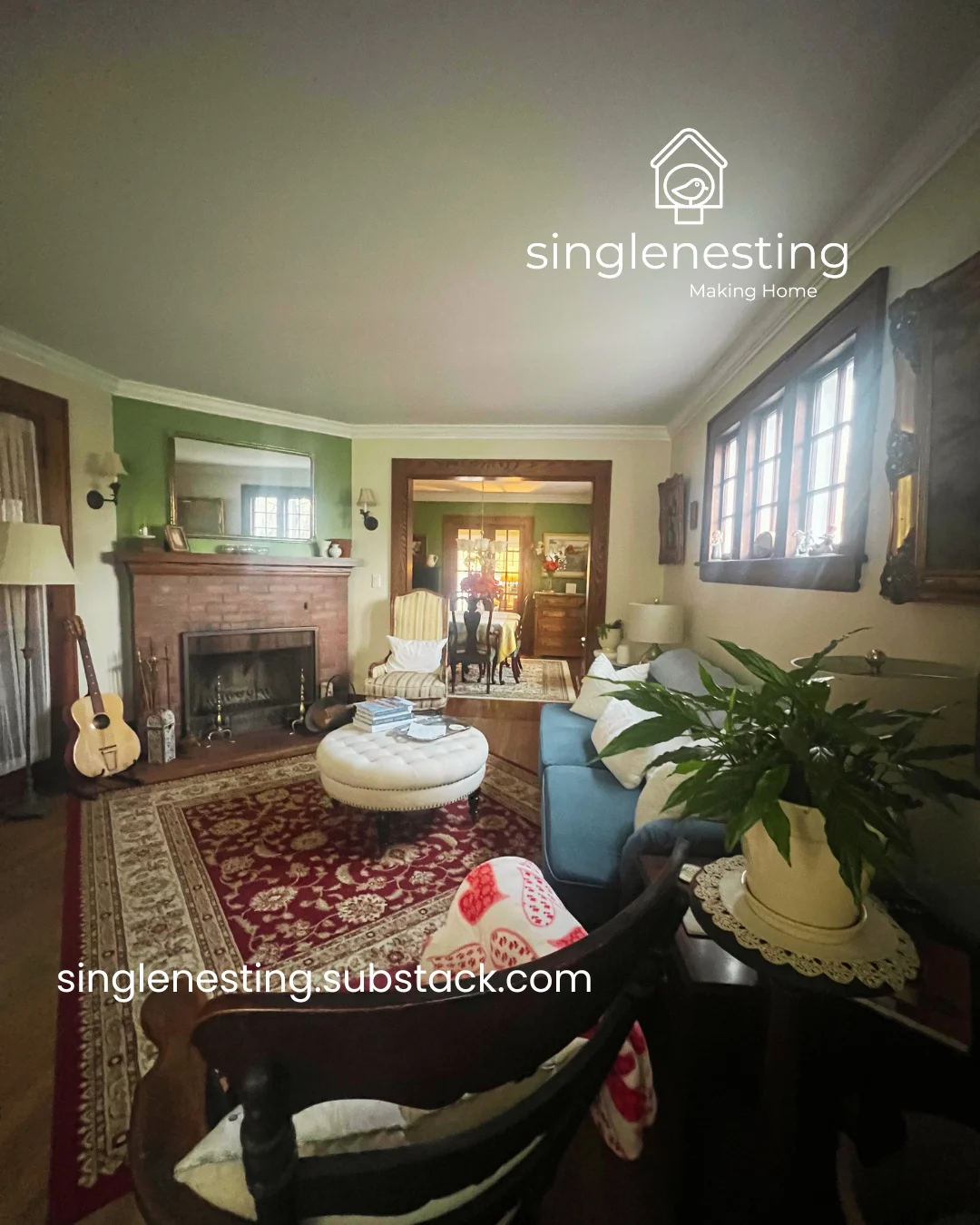
A middlemalist home is edited but not empty. It contains things that have been chosen with care. Things that have been inherited, found or saved for. Things that carry meaning. It does not contain things kept out of obligation or because you’re resistant to changing them. Middlemalism allows you to keep the stuff that you love and rotate it in and out as the seasons or your whims direct. Surfaces aren’t bare, but they’re also not overly crowded. There might be a little bit of stuffing things in on a bookcase in one room while in another, the table holds only a beautiful tablecloth and a simple vase of fresh flowers from the garden. In either case, there’s space for the eye to rest on the things you love.
It’s warm rather than clinical. The materials tend toward what’s pleasing to the touch. Think natural fabrics like linen, warm wood grains, smooth ceramic, aged brass, worn leather. The palette leans muted, natural or earthy rather than stark. Middlemalism isn’t afraid of color or pattern and uses each with restraint and purpose. There are soft things: a throw, a rug, cushions that look like someone actually uses them.
It’s lived-in rather than staged. Books are read and left where they were read, not just displayed. Plants are real and occasionally imperfect. The lamp in the corner is there because it gives good light and was your grandfather’s, not because it was styled there. The home looks like someone inhabits it with loving intention and without perfectionist anxiety.
What it is not: a show home, a mood board made three-dimensional, a minimalist space with a few props added for warmth or a maximalist space with things removed. Middlemalism is its own thing and you recognise it immediately when you walk into a room that has it.
📚 Related Reading → The Middlemalist Home: Finding the Balance Between Minimal and Lived-In |
Why Neither Extreme Quite Works
Minimalism, at its most rigorous, asks you to want less. That’s a reasonable enough philosophy, and in some forms it can be a genuinely liberating one. But it often tips into a kind of austere aesthetic that treats warmth as clutter and personal history as noise. The result can be a home that’s calm in the abstract and a little bit alienating in person. The kind of space that performs stillness rather than actually providing it. The self-imposed pressure to achieve perfect minimalism can actually cause feelings of failure if the achievement falls short of the mark.
Maximalism asks you to want more, and more specifically, to display more. At its best it is joyful and personality-filled and gloriously specific. I’ve heard it described as clutter-core. But it requires either a large space, a significant budget or a very particular kind of confidence - the kind that calls for a sort of reckless abandon. And, while impressive at first glance, I’ve found it can slide quickly into visual overstimulation. This can be especially true in a home you share or don't fully control.
Most of us live somewhere in the middle of this. Not because we haven't committed to an aesthetic, but because the middle is where real life actually happens. We have some things we love and some things we're keeping until something better comes along. We have heirlooms and treasured finds and practical objects and one or two things that are just beautiful for no particular reason. We’re not starting from scratch, and our homes shouldn't pretend we are.
Middlemalism is the aesthetic that honours that reality. It doesn't ask you to want less or more. It asks you to be more intentional about what you keep and how you place it. It invites you to let the result feel like you, not like a showroom.
The 5 Hallmarks of a Middlemalist Home
1. Intentional editing, not emptiness
A middlemalist home has been thought about. Things are there because they were chosen, not because they accumulated. But editing doesn't mean minimising; it simply means knowing what earns its place and letting go of what doesn't. This can be achieved with rotating your loved pieces in and out. The result isn't a bare room, rather it's a room where everything visible has a reason to be there, even if that reason is simply that it's beautiful or beloved.
2. Warmth as a non-negotiable
Warmth is built into the aesthetic at the material level. Wood, linen, ceramic, wool, natural fibres, aged metals. All these are the materials of a middlemalist home because they read as lived-in from the moment they arrive. A room furnished entirely in cold materials like glass, chrome, lacquer, synthetics can be edited and intentional and still feel like a lobby. Middlemalism chooses warmth first.
3. Personal history woven in
The objects that make a home feel specific to its inhabitant are almost always the ones with history: the piece inherited from a grandmother, the artwork bought on a trip, the ceramics made by someone whose work you admire. A middlemalist home makes room for these things deliberately rather than treating them as exceptions to a decorating scheme. The history is part of the aesthetic, not a departure from it.
4. Layering without crowding
Layering is how a middlemalist home achieves its particular richness. The rug under the coffee table, the throw over the arm of the sofa, the stack of books beside the lamp. But the layers are considered: each one adds texture or warmth or interest without tipping the room into visual noise. The difference between layering and cluttering is usually a question of scale, colour harmony and the willingness to edit.
5. Beauty without performance
A middlemalist home looks good, but it doesn't look like it's trying to look good. There is a difference between a room that has been styled and a room that has been lovingly put together. Middlemalism sits firmly on the loved side of that line. The things in the room are there because they are genuinely useful or genuinely pleasing. They’re not there because they photograph well or signal a particular taste. The room feels like a home someone lives in, not a home someone curates.
What Middlemalism Looks Like When the Home Isn't Entirely Yours
One of the things I find most honest about this aesthetic is that it works in imperfect circumstances. Which is to say, it works in most homes. Rented spaces. Shared spaces. Homes you're living in temporarily. Rooms you don't have full control over.
The middlemalist approach to a rented home is not to wait until you own something before you make it beautiful. It’s to work within the constraints. You know, the landlord's carpet, the fixed kitchen units, the walls you can't repaint and then layer in warmth through the things you can control: textiles, lighting, plants, objects with meaning, art propped rather than hung, books stacked up in piles on the floor.
In a shared home, it may mean a bedroom that is entirely yours and communal spaces that are negotiated. It may mean making your corner of a shared room feel settled and considered even if the rest of the room isn't. Middlemalism doesn't require a whole house. It requires intention in the space you have.
- Start with the surface you look at most
- Add one warm material: a throw, a rug, a plant
- Remove one thing that doesn't earn its place
- Add one thing with personal history, however small
You don't need to redecorate. You need to consider what's already there with a little more intention.
📚 Also worth reading On simplifying your home as a foundation for this aesthetic: → Simple Home Organization and Systems That Make Everyday Life Easier |
Why This Matters More Than It Might Seem
There is a version of home decorating that is essentially aspirational. It’s always pointed toward the home you will have one day, the renovation that will make it work, the budget that will eventually allow the thing you actually want. Middlemalism is the opposite of that. It starts with the home you have.
This isn’t about settling. It’s about the genuine pleasure of a room that feels like yours, rather than a room that is waiting to become something else. It’s a room, a home, that reflects your history, your interests, your particular way of being in the world. The homes I find most beautiful and most restful are almost never the ones with the largest budgets or the most coherent design vocabulary. They’re the ones where it is immediately clear that someone lives there and loves it.
Decorating slowly, intentionally and with warmth does not come from a position of compromise. It’s a philosophy. And it’s what produces homes that age well, feel honest and offer the particular kind of comfort that only comes from a space that has been genuinely inhabited.
That’s what middlemalism is aiming for. Not perfection. Not the photoshoot version. Just a home that feels, unmistakably, like yours.
📚 Recommended Reading → Decorating Slowly and With Intention: How to Create a Home That Reflects You → What Simple Living Looks Like When Your Home Doesn’t Look Like Everyone Else’s |
✉ Come Find Us in Your Inbox If you are building a home that feels warm, intentional, and genuinely yours and not styled or aspirational, just honest, you’re invited to join Singlenesting Letters. Each week you’ll receive a gentle letter on thoughtful, practical ideas for homemaking in a home that doesn't look like the standard picture.
|
🔎 Explore the Archives Looking for more on Home Style and slow decorating? |