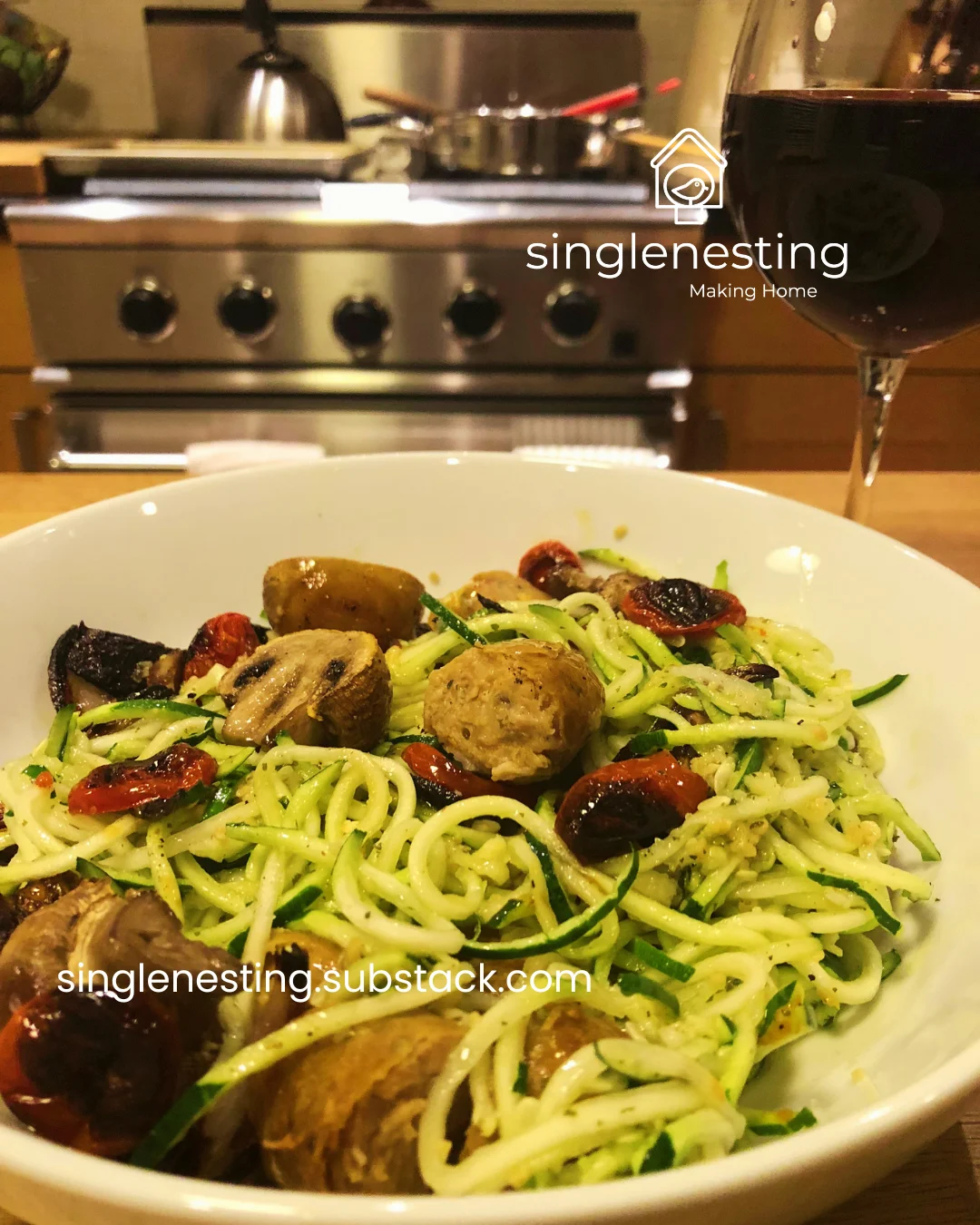
How to Actually Enjoy Cooking for One: A Guide to the Solo Kitchen
It took me quite a bit of time cooking for one before I got the hang of it. And if you've ever searched for advice on cooking for one, you've probably noticed that most of it assumes you're trying to solve a problem.
How do you spend less? How do you avoid leftovers? How do you meal prep more efficiently?
Those questions matter but they aren't really the whole story.
Because for many of us, the challenge isn't simply figuring out what to cook. It's learning how to enjoy cooking for one in a culture that treats shared meals as the default and solo meals as second best.
Whether you live alone, share an apartment with roommates, occupy a floor of a multigenerational home or simply find yourself preparing most of your own meals, the solo kitchen deserves more than survival strategies.
It deserves attention, it deserves pleasure and it deserves a place within the rhythms of homemaking.
In this guide, we'll explore what cooking for one can look like when it's approached from a place of being a meaningful way of caring for yourself, rather than a compromise.
✉️ A Gentle Weekly Letter
If you're creating a home life that feels nourishing, intentional and your own, you're invited to join Singlenesting Letters.
Each week, I share reflections on homemaking, simplicity, everyday rhythms and seasonal living.
→ I'd Love a Gentle Weekly Letter
Cooking for One Is Not a Lesser Version of Cooking
One of the biggest obstacles to enjoying cooking for one is the framing around cooking in general.
We understand that cooking is primarily an act performed for others. We celebrate dinner parties and holiday meals and family gatherings while we envision large tables filled with people clinking their glasses in a toast. That’s how I have, at least.
I’m not knocking any of those situations because each one of those things are wonderful. Beautiful. Each has their time and place.
But they can also, unintentionally, leave the solo cook feeling invisible.
The truth is that preparing a meal for yourself is not a lesser form of cooking. As a matter of fact, it's still hospitality.
The guest simply happens to be you.
Cooking for one might look like:
- Making a full breakfast before work.
- Preparing a favorite comfort crockpot meal on a rainy afternoon.
- Lighting some candles for dinner.
- Taking time to set a place at the table with the special china and crystal.
- Learning a new recipe simply because it sounds interesting.
The solo kitchen isn't a waiting room for some future or imagined life.
It's part of your life now.
📚 Recommended Reading
→ Simple Home Hospitality: How to Gather People Without Making It a Production
→ Simple Living for Beginners: A Gentle Guide to Starting Slow
The Difference Between Feeding Yourself and Nourishing Yourself
Many people who dislike cooking for one aren't actually struggling with the cooking part. What they're struggling with is the motivation part.
When nobody else is waiting for dinner, it can feel easier to just grab a snack, graze to take the edge off or skip the effort altogether.
Here’s where a helpful distinction emerges: feeding yourself answers a practical need, whereas nourishing yourself answers a human one.
Both matter.
A nourishing meal doesn't mean it has to be elaborate. In fact, it's often surprisingly simple.
It might include:
- Food you genuinely enjoy.
- A comfortable place to sit.
- A pause between work and evening.
- A small ritual that signals self-care.
When we focus only on efficiency, cooking can begin to feel transactional.
When we include nourishment, it becomes a part of homemaking.
Five Habits That Make Cooking for One More Enjoyable
The good news is that you don't need to overhaul your entire kitchen routine. You can start with a few gentle shifts.
1. Stop Waiting for Special Occasions
Many solo cooks save their favorite ingredients, recipes, dishes or traditions for when guests arrive.
But your ordinary Tuesday deserves some attention too. Use the good bowl. Buy the seasonal Trader Joe’s special cheese. Make the pasta you love.
Part of enjoying cooking for one is recognizing that everyday life is worthy of intention and care.
2. Build Meals Around Ingredients You Enjoy
Many meal plans are built around efficiency. Making enough to freeze, which is a great habit that your future self will thank you for. However, the solo kitchen often benefits more from delight.
Choose one ingredient each week that you're genuinely excited about cooking. These could be fresh herbs or a beautiful loaf of bread, or perhaps seasonal fruit and a favorite cheese.
Interest creates momentum.
3. Embrace Planned Leftovers
This is where your future self will be grateful because the goal isn’t to eliminate leftovers. The goal here is to make them useful.
Roast vegetables that can be added to salads later in the week. Prepare grains like quinoa that go with other types of dinners. Cook enough extra angel hair on Tuesday that can be recooked with an asian-inspired meal on Thursday.
Leftovers become frustrating when they happen accidentally. But they become helpful when they happen intentionally.
4. Create Tiny Rituals
An important thing to keep in mind is that a solo meal doesn't become meaningful because of the complexity of the recipe. If you’d like to cook a three course meal for yourself, by all means, do that and celebrate and enjoy.
A solo meal becomes meaningful because of attention.
Try:
- Setting a beautiful placemat.
- Playing music to fit your mood.
- Using a cloth napkin.
- Sitting down before taking the first bite.
- Praying a blessing over your meal.
Small rituals help separate a meal from the rest of the day. Being intentional about that separation is the way to make your solo meal special for yourself.
5. Learn a Handful of Flexible Recipes
The most useful solo recipes aren't necessarily recipes at all. Think of them more as templates.
One of my favorite methods is to think of my favorite main ingredients and research some recipes on how to cook them, taking a little bit from this recipe over here, from that recipe over there and making it my own.
You could come up with simple pasta dishes, roasted chicken thighs and vegetables, different flavors of grain bowls or soups.
Adaptable meals reduce decision fatigue while still allowing creativity.
🛒 Pantry Staples & Solo Kitchen Tools
→ A half-sheet pan sized appropriately for smaller portions.
→ Stackable glass containers that make leftovers easy to see and use.
→ A small Dutch oven for soups, grains and one-pot meals.
Cooking for One in a Shared Kitchen
One of the biggest blind spots in cooking-for-one advice is the assumption that you have an entire kitchen to yourself. I understand that many of you don't. Personally, I’ve always had a shared kitchen in one form or another.
You may share a kitchen with roommates.
You may live with aging parents.
You may share space with adult children or extended family members.
You may be cooking for yourself while living among other people.
This creates unique challenges but also unique opportunities.
If You Live With Roommates
Cooking for one in a shared household often requires flexibility rather than perfection.
A few practices can help:
- Keep your most-used ingredients organized and accessible.
- Choose one or two regular cooking windows each week.
- Clean as you go whenever possible.
- Embrace simple meals on busier evenings.
The goal isn't to create a YouTube-worthy kitchen routine. Rather, the aim is to create a kitchen routine that works within the realities of a shared space.
I’ve found that there's also something quietly comforting about cooking for yourself while life happens around you. The sounds of roommates coming and going, brief greetings and conversations about one another’s day creates a sense of community without requiring shared meals every night.
If You Live in a Multigenerational Home
Cooking for one in a multigenerational household can have a tendency to feel complicated.
You may share pantry space and have to coordinate refrigerator shelves. Or, you may navigate different dietary wants or needs and meal schedules.
But it can also create an unanticipated yet delightful richness.
You might cook your own dinner while preparing tea for a parent. Maybe you share ingredients while maintaining separate meals. Perhaps you exchange recipes across generations.
This isn't necessarily about complete independence from one another.
Rather, think of it as creating enough ownership of your kitchen rhythms to support your own nourishment.
If You're the Only Person Who Cooks
Some of you may find yourself in a different situation entirely. Perhaps you live with others but are primarily responsible for your own meals.
In this case, I’ve found that it helps to release the expectation that every meal must feel communal.
A solo meal prepared intentionally isn’t a sign of isolation. It's simply one expression of daily personal care.
Where to Begin
If you're not sure where to start, begin here:
- Choose one meal each week to make with extra care.
- Learn three recipes you genuinely enjoy.
- Set a place for yourself at the table instead of eating on the couch in front of the tv.
- Keep ingredients for one easy comfort meal on hand, in your pantry.
- Stop apologizing for cooking only for yourself.
One of the most surprising things about the solo kitchen is that enjoyment often comes from consistency rather than excitement.
A handful of satisfying meals repeated throughout the seasons can create a sense of comfort and rhythm that complicated meal plans rarely achieve.
Why the Solo Kitchen Matters
We often imagine that homemaking only becomes meaningful when it serves the other people living in the home. And that is not wrong.
But homemaking also matters when it serves the person living inside the home, even if the person is only you.
Cooking for one is one of the clearest examples of this because nobody may ever compliment the meal or photograph it. Nobody other than you may know how much care went into preparing it.
It still matters.
Your kitchen doesn’t need to produce impressive meals.
It simply needs to:
- Support your daily life.
- Offer nourishment.
- Create moments of beauty and tending.
Don’t think of the solo kitchen as a consolation prize. Reframe it as a place where ordinary life unfolds.
And ordinary life is worthy of nurturing.
🌿 Lifestyle Favorites
→ A favorite mug used only for slow mornings.
→ A handwritten recipe notebook filled with meals you actually make.
📚 Recommended Reading
→ Cooking for One Without Waste: 8 Simple Ways to Create a Gentle Kitchen Rhythm — Practical strategies for reducing food waste while cooking solo.
→ What to Always Have on Hand for Easy, Last-Minute Meals — How to stock ingredients you'll actually use.
→ A Refreshing Cocktail Perfect for Late, Hazy Summer Days — A simple recipe you can enjoy on your own.
→ Hospitality the singlenesting Way: A Simpler, More Personal Approach to Gathering — Bringing others to the table without turning hosting into a performance.
✉️ JOIN THE NEWSLETTER
Come Find Us in Your Inbox
If you're creating a home life that feels nourishing, intentional and your own, you're invited to join Singlenesting Letters.
Each week, I share thoughtful, practical ways to make everyday homemaking feel calmer, simpler and more meaningful.
🔎 SEARCH THE SITE
Looking for more ideas on cooking, food and everyday kitchen rhythms?
Explore the At the Table archives and find what resonates.