The Definitive Coffee Table Dipping Books Guide
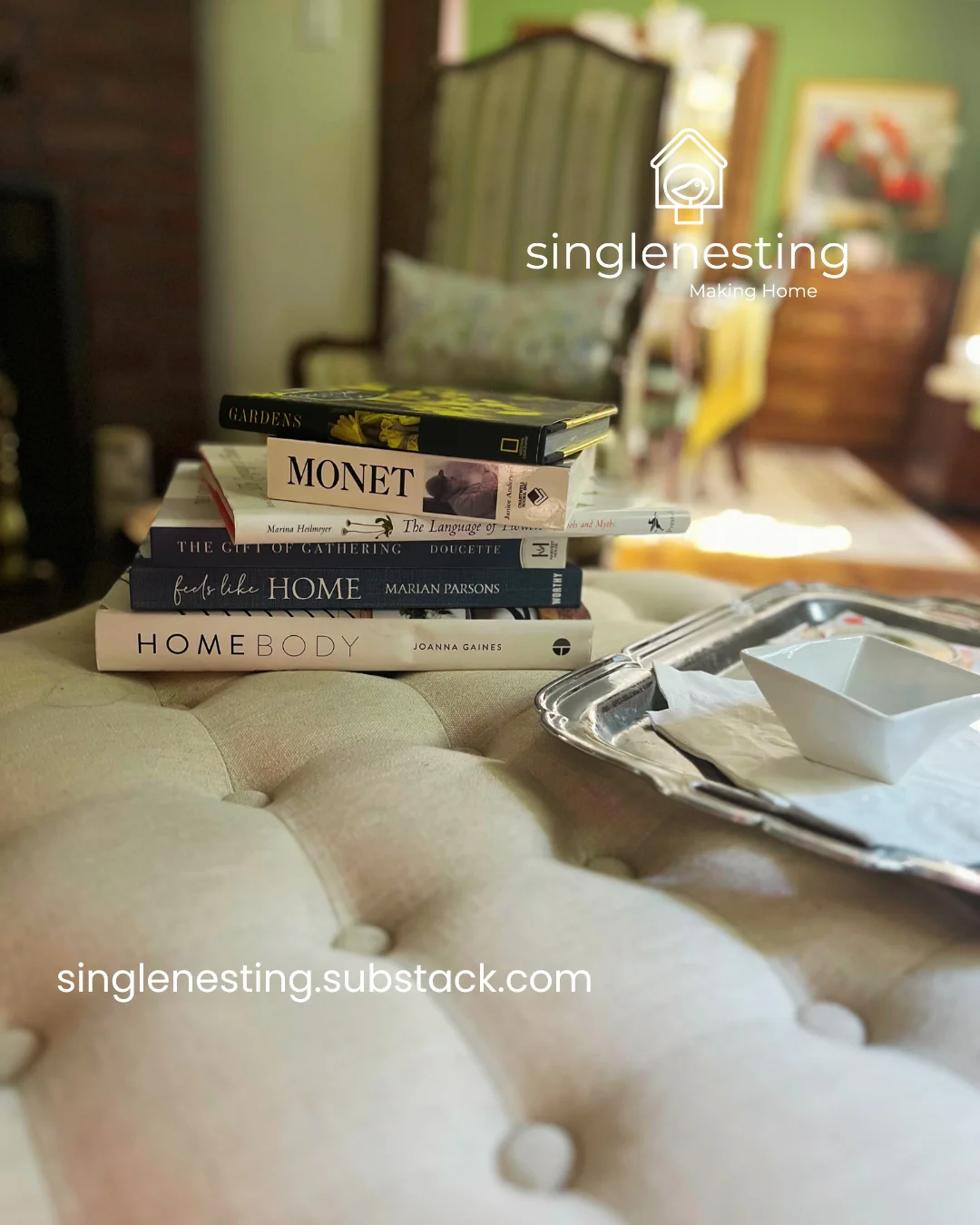
I’ve finally accepted that there's a kind of book that isn't meant to be finished. It sits out where you can see it, gets picked up for five minutes on a puttering day or ten minutes with tea, and never once makes you feel as though you’re behind. On Singlenesting, I like to call these types of books coffee table dipping books. If you've never had a name for that stack of beautiful, browsable books on your side table, this is the guide that finally gives you one.
A lot of decor advice says that coffee table books are there for aesthetics and to “add height” to other decor pieces. But that advice doesn’t always resonate with the true book-lover.
Most reading expectations assume a straight line: start on page one, finish on the last page, move on to the next title. That's the way you’d want to read a novel, but it doesn’t quite work the same way to read a book of photography, a collection of essays, or a volume of poetry meant to be opened at random, don’t you think? Coffee table dipping books were never supposed to be raced through. They're meant to be returned to, again and again, in small unhurried visits.
In this guide you’ll find everything I’ve written about the concept so far. We’ll start with the original post that introduced the term, and then move on to the framework for building a stack of your own, whatever your space or budget looks like.
If you've been collecting beautiful books you never quite "get to," you're not doing it wrong. You just haven't been taught that dipping in is the whole point.
A GENTLE WEEKLY LETTER If you'd love more slow, unhurried ideas like this one in your inbox, you're invited to join Singlenesting Letters, weekly reflections on homemaking, simplicity and everyday rhythms. |
What Makes a Book a Coffee Table Dipping Book
A coffee table dipping book is any book designed to be opened anywhere and still make sense. There’s no plot to lose track of, no chapters you have to read in order. It's not so much a genre as a way of approaching a book.
It could be something along the lines of:
- A photography or design book you open to whatever page falls open
- A collection of essays where each piece stands entirely on its own
- A volume of poetry meant for one poem at a time, not a sitting
- An illustrated reference book in subjects such as botany, history or architecture, that’s built for browsing
A coffee table dipping book is not a novel you're "reading slowly" or a self-help book you've stalled out on. Those are unfinished books that may be worth considering adding to your DNF (did not finish) pile. Or, just a pile that’s for books it isn’t the time for. A coffee table dipping book was never really meant to be finished in the first place. And that's the whole appeal. Once I discovered that I didn’t have to pressure myself to finish these types of books, or read them in a linear path, I realized it was worth naming as its own category.
RECOMMENDED READING→ read the original coffee table dipping books post — where the term started → Slow Hobbies for a Full Home Life — the fully rounded ideas this guide supports |
Why Dipping Beats Reading Cover to Cover For This Kind of Book
If you’re like me, you’ve felt that unspoken guilt that builds around unfinished books. So let’s face it together by naming it directly: that guilt only makes sense for books meant to be finished. A coffee table dipping book isn't failing you if you haven't read it from start to finish. Additionally, and this is the key, you’re not failing it. You're simply using it exactly as intended.
It helps to think of it this way:
- A novel builds toward something and skipping around loses the thread
- A dipping book is built from self-contained pieces and skipping around is the intended experience
Once you stop measuring these books by pages read, they stop being a source of silent failure and start being what they were meant to be: something beautiful you return to, not a task you owe it or have self-imposed.
Five Categories to Build Your Coffee Table Dipping Books Stack
A good stack has range. Think in terms of something visual, something written and something seasonal. Here's where you can start.
Photography and place books: Large-format books built around a single subject: a city, a landscape, a craft. These are the easiest entry points because the appeal is immediate; you don't need context to open one and linger. And you can buy one that strikes your fancy, infusing your personality into your home.
Essay collections: Look for collections explicitly built from standalone pieces rather than a connected memoir. Each essay should work as a visit of a few moments, not a chapter in an argument you'll lose track of.
Poetry: One poem, from time to time and as the whim takes you, is enough. Poetry collections may be the purest form of a dipping book because they were never meant to be read in order in the first place.
Art and design books: Fashion, architecture, specific artists or designers, decor, textile and pattern books. These reward flipping more than almost any other category and tend to be genuinely beautiful objects on a table.
Illustrated reference: Field guides, culinary reference, botanical books. Slightly more practical than the others, but no less browsable, and often the books people pick up most often without realizing it.
Where to Begin: Building Your Own Stack
Ready to start your own collection but don’t know where? Try here:
- Pick two categories from the list above, not all five. A focused stack feels intentional, a scattered one can feel like clutter
- Start with books you already own before buying anything new. Most people have at least one dipping book hiding on a shelf, so scour your own before scouring Amazon
- Keep the stack small. Three to five books is plenty and you don’t want a tower that could be knocked over. A coffee table is only a library if you want it to be
My own collection started naturally and for “someday.” Having always been an avid reader, I was drawn to beautiful books about subjects that I found interesting, and lots of subjects interest me! I started by collecting the discounted books at Borders, Barnes & Noble or library booksales, usually history or home decor. I keep some out and others tucked into bookshelves. Whenever I feel like a refresh, I rotate some, either seasonally or by topic.
I do want to note that once I stopped feeling behind on any of them and started just opening them when I had a few quiet minutes, the guilt from not finishing them disappeared and the dipping habit stuck. And now I’m growing my own collection with the addition of poetry and nature essays.
Why This Kind of Reading Belongs in a Slow Home
Coffee table dipping books fit the same philosophy as everything else here on Singlenesting: not everything in a calm home has to be finished, optimized or completed in order to be worthwhile or hold value. Some things are simply there to be returned to and loved because you like it.
If there’s anything your home doesn't need, it’s a reading list you're “behind” on. But it could maybe use:
- A few books that reward five unhurried minutes, not a five-week commitment
- Permission to open a book at random and call that reading
- A small, visible reminder that slowness is allowed here
Recommended Reading
More from A Bit of Whimsy:
→ Slow Hobbies for a Full Home Life — the philosophy behind slow, analog hobbies like this one
→ Starting a Journaling Ecosystem as a Hobby — another slow, dip-in-and-out home practice
Related from Home Style:
→ Decorating Slowly and With Intention — for creating the reading nook these books can live in
✉️ JOIN THE NEWSLETTERCome Find Us in Your InboxIf you're creating a home life that feels thoughtful, creative and deeply your own, you're invited to join Singlenesting Letters.
Each week, I share gentle and reflective thoughts on homemaking, simplicity and the art of living well at home.
|
🔎 SEARCH THE SITELooking for more slow, analog ways to fill your time? Explore more in the A Bit of Whimsy archives. |